
It is nearly impossible to keep track of the amount of sharks living in our marine environments, but there are some methods that allow us to determine population trends. One of these methods is called a fishery dependent population survey. fisheries are legally required to keep a detailed record of their catch (and bycatch) and researchers can use these records to assist in determining population trends.
Dr. Julia Baum (2003) and her team did just this in a popular article titled “Collapse and Conservation of Shark Populations in the Northwest Atlantic.” Their results were shocking in that they found that from 1986 to 2003 analysis of logbook data suggests a population decline of 89% in hammerhead sharks, 79% in great white sharks, 65% in tiger sharks, 80% in thresher sharks, 60% in blue sharks, and 70% in mako sharks (Baum et al., 2003).
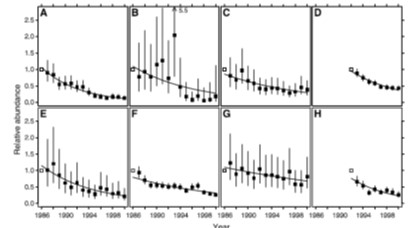
Declines in estimated relative abundance for coastal shark species: (A) hammerhead, (B) white, (C) tiger, and (D) coastal shark species identified from 1992 onward. As well as oceanic shark species: (E) thresher, (F) blue, (G) mako, and (H) oceanic whitetip. (Baum et al. 2003)
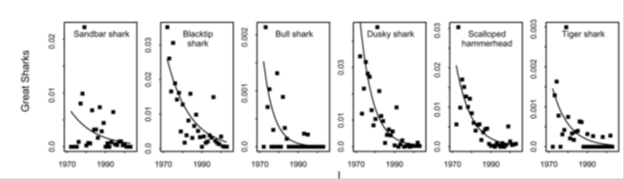
Another method to determined population trends in sharks are fishery-independent surveys which are usually conducted by universities or governments. A 2007 paper titled “Cascading effects of the loss of apex predatory sharks from a coastal ocean” used an ongoing fishery-independent survey from 1972 in North Carolina state waters. shockingly, all of the sharks in the survey had decreased within 35 years, some by over 90% (Myers et al., 2007)
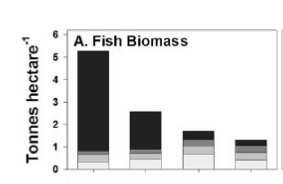
Another way to observe the decline in shark populations is to observe their biomass in pristine, unfished ecosystems. As fishing becomes more high-tech, these environments become less and less. However, an expedition to the relatively-pristine Northern Line Islands in 2010 determined that there are a lot of sharks, which the authors of the article titled “Baselines and the degradation of Coral Reefs in the Northern Line Islands” refer to as an “inverted trophic pyramid!” Additionally, the relative number of sharks changes proportionally with fishing pressure (Sandin et al. 2010).

 Sharks Are Important Too!